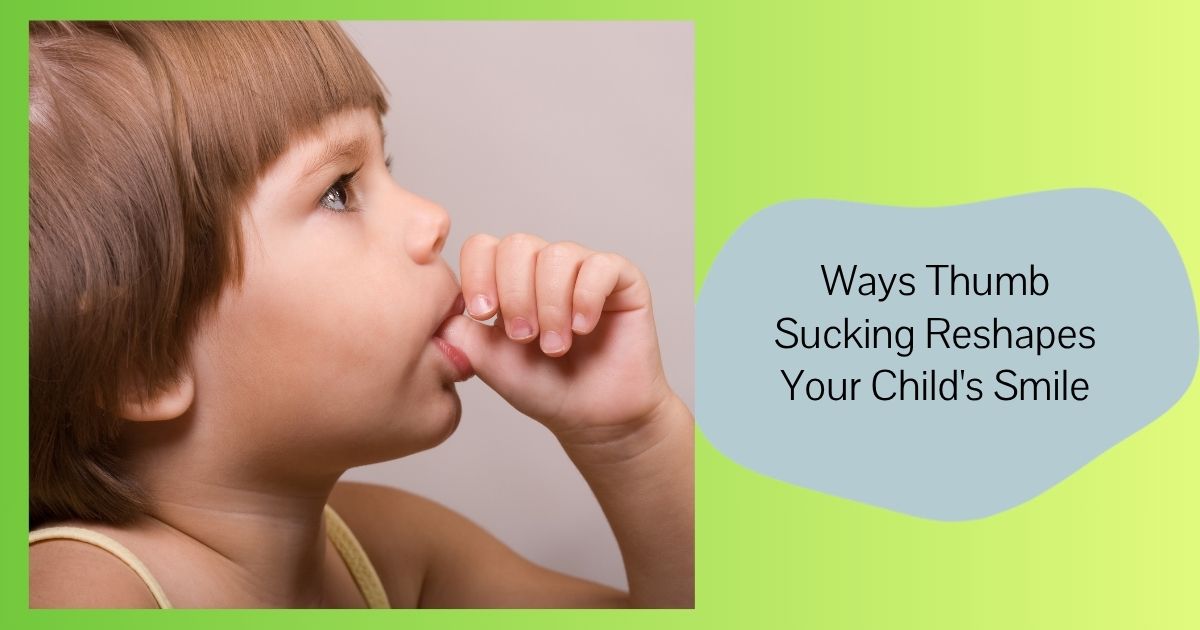
One of an infant’s most natural reflexes is thumb sucking. It gives them solace, aids in self-soothing, and mostly results in restful sleep. The majority of parents believe the habit will just go away on its own. It does go away for a majority of kids. However, thumb sucking ceases to be innocuous around the age of four or five. This is true if the child sucks the thumb frequently and intensely. Your child’s smile might literally change due to the continuous pressure of a thumb against growing teeth and developing jawbones. The alterations are aesthetically pleasing and also impact speaking, breathing, and eating.
How the Damage Happens: Pressure Over Time
A thumb is soft but persistent, in contrast to a pacifier. It has a uniform shape and little pressure. The force and angle of a thumb are under the child’s control. In contrast to passively resting the thumb in the mouth, prolonged aggressive sucking produces outward pressure on the lower front teeth and inward pressure on the upper front teeth. This imbalance causes teeth to shift from their natural locations over the course of months or years, changing the palate’s (the roof of the mouth) form.
The 7 Specific Changes to Your Child’s Smile
The effects of extended thumb sucking on a child’s developing mouth are listed in order of frequency to severity.
- Open Bite: When the rear teeth are closed, the upper and lower front teeth are no longer in contact. This makes it difficult to bite into items like sandwiches or corn because it leaves a visible gap that can capture the tongue.
- Protruding Upper Front Teeth (Buck Teeth): The upper incisors are forced both outward and forward. This makes them more vulnerable to injuries which can be caused due to playing or a fall.
- Flared Lower Front Teeth: The Lower incisors’ natural alignment with the upper teeth is disturbed by their tilt. The tilt can be both inward or backward towards the tongue. Flared upper and lower front teeth can cause open bite.
- Narrowed Upper Arch (Crossbite): The perfect question to be asked is – “Does the palate get wider due to continuous thumb pressure?” The answer to this is “No”. It actually narrows the upper jaw by preventing normal lateral expansion. A disorder known as posterior crossbite occurs when the upper back teeth bite inside the lower back teeth.
- Speech Difficulties: Certain consonants like “s,” “z,” “t,” “d,” and “n,” are difficult to pronounce correctly when one has an open bite or an altered tongue position. Parents can notice either a lisp or a slurred pronunciation.
- Tongue Thrust Swallow: Ideally when swallowing the tongue is positioned up against their palate. When a child swallows abnormally, their tongue pushes forward against their front teeth. This keeps the bite open even after thumb sucking has stopped.
- Changes in Facial Profile: The upper jaw does not grow forward sufficiently in instances where the condition may be severe or chronic. This can last into the early adolescent period. A weak chin and a prominent nose can give the face a “dish-shaped” appearance.
- Apart from oral problems, children experience upper respiratory infections and mouth breathing too. Mouth breathing is forced by a constricted airway and high-arched palate. This decreases nasal airflow on one hand. It increases colds, ear infections and tonsillitis. It also impairs the quality of sleep. This can lead to restlessness and exhaustion during the day.
Passive vs. Active Sucking: Does Intensity Matter?
Yes, to some extent. Some infants might suck their fingers furiously. But when a child merely rests their thumb passively in the mouth, they produce less harm. When a child indulges in active sucking, calluses are produced on the thumb. Along with that, clicking noises made when sucking or obvious movement of the mouth and cheeks are few of the other indicators of active sucking. Dental alterations will occur more quickly and severely if the habit is more serious.
When to Intervene and How
Most children stop thumb sucking between 2 and 4 years of age. If the habit continues even after 4 years, or if you already notice any of the changes mentioned above, intervention is required. Gentle reminders, positive reinforcement and identifying triggers like anxiety, boredom or fatigue are some factors that work well for many children.
Applying neem oil on the thumb can be tried initially. If the habit continues even after applying neem oil, visit a dentist. Your dentist will then recommend a fixed or a removable habit-breaking appliance. This small device makes thumb sucking uncomfortable. It does not cause any pain. These appliances are custom-fitted, non-invasive and highly effective. They are mostly worn for 4 to 6 months. Early intervention prevents prolonged dental changes. It also reduces the need for complex orthodontic treatment later.
Early Help Prevents Long Procedures
The ideal time to address thumb sucking should be as early as possible. This can occur around age 6-7. Correcting a fully developed malocclusion years later is much more difficult, time-consuming and costlier than early intervention. Seeking competent Kids Dental Treatment in Chennai can offer a clear road map that safeguards your child’s smile for life, from behavioral counsel to habit-breaking tools.